
Sharpe's flogging
 I've just started reading the first book of the Sharpe series by Bernard Cornwell - the ones that were made into a tasty TV BBC costume drama starring Sean Bean. The first book, Sharpe's Tiger, predates the first plotline of the TV show, presumably because it's set in India and they didn't have the budget.
The villain, Sergeant Hakeswill, is one that reappears in the TV episodes Sharpe's Company and Sharpe's Enemy, in which he gets Sharpe's friend Harper unjustly flogged. The whipping in the BBC version is somewhat anticlimactic Of course, a flogging with authentic blood and gore would be too much for the BBC (although inconsistently, they're happy enough to include a certain amount of blood and gore in the battle scenes).
I know that actual military floggings were far more horrific. Thanks to poor medical care (and a lack of will in carrying what knowledge they had out responsibly) a small sentence could be lethal due to the chance of infection; but even without that factor, a sentence of one or two hundred lashes could easily kill someone. The leather thongs tear the flesh away from the bones and the flesh is shredded to ribbons. I found the flogging scenes in Naomi Novik's Temeraire books far more realistic, and simultaneously more sensitive: 40 lashes is seen as a severe sentence which the captain is unwilling to give out; he forces himself to watch it, suffering all the while; and the miscreants stay in the sick bed for several weeks afterwards. By contrast, the scene in Sharpe's Tiger is extravagantly, sensationalistically, horrific: Cornwell's only aim is to heighten the anticipation and horror, and few of his characters show any humanity or sensitivity.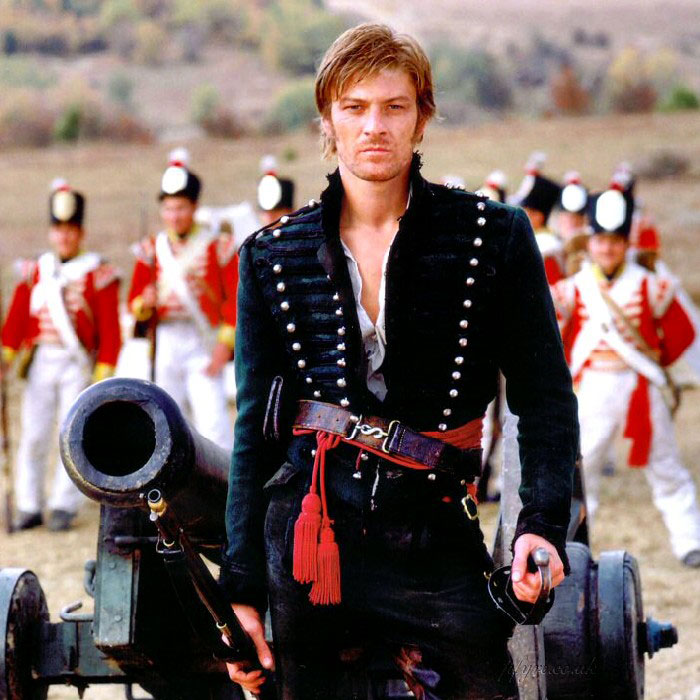 Anyway, I tucked into the first book delightedly, pleased to be able to read about characters I have long loved. I love Cornwell's other historical fiction and I had high hopes. But the first section of the book is all about how horrible it is to be flogged (and how horrible it is to be a soldier in every other way, but with a perverse fixation on the flogging) and then how horrible Hakeswill is, and how Hakeswill is definitely going to get Sharpe flogged and how horrible that's going to be. I knew Sharpe did get flogged in this book because I'd been spoilered by the TV show, but the sensationalistic anticipation about how awful it was going to be was so unbearable that I did something I very rarely do. I skipped ahead.
I skipped ahead, past all the other plotlines, past how Hakeswill achieves it, to the flogging itself. Which was, if anything, even more horrific and extreme and gory than I had imagined, partly because Sharpe is given a sentence which massively exceeds the maximum historical sentence of 1 200 lashes. Of course no-one could survive that, so of course he is saved by an even unlikelier sequence of events. The unrealistically excessive sentence and the equally unrealistic rescue were just as disappointing as the weedy, unbelievable flogging shown on screen in the TV show.
The more brutal tortures used as disciplinary methods in historical contexts are not always interesting to me: the naval horror stories are mildly fascinating, and their background presence adds tension to any naval scene, but I wouldn't want to read a detailled account of one actually being carried out; I certainly wouldn't want to read an account from the perspective of the victim. I was expecting Sharpe's flogging to be slightly sexy, and when the first anticipatory hints were dropped in the opening pages my heart definitely started racing. But my horror and dismay quickly overtook any erotic fear I was feeling, and the actual scene turned me right off.
British military floggings were horrific and gory and brutal, and often just a slow and agonising death sentence. In my fantasy life, they far more often appear as the-threat-which-is-never-carried-out, or as vague background texture which is never made explicit. I squirmed during the scene in the Temeraire series, but I think that level - 40 lashes viewed by sympathetic characters - represents the most extreme edge of my interest in actually imagining the experience of a flogging in any empathic detail. More than that and it's like any other torture porn - mildly fascinating in the abstract, but increasingly disgusting and upsetting as more detail is included, all the more if it's based on real events.  Am I just getting more sensitive as I age? Is it that the more real, historical brutality and gore I learn about, the less interested I am in including it in my fantasies? I'm not sure how much I was ever interested in scenarios this extreme. And while I get much more upset and angry about real-life rape and assault these days than I used to, I still fetishize similar acts in a consensual/fantasy setting. So I'm not sure that's it.
When I think about it, I've always shied away from reading about this sort of thing in detail - but when I was younger, that reticence was characterised by a squirmy, guilty, shameful excitement. I didn't read more because I was excited by the idea, and I was ashamed of being excited. These days, that shame isn't there: so I look deeper, at which point I discover that I lack the stomach for depictions of real atrocities carried out against real people, and often can't prevent myself from imagining the experience, which is upsetting and not particularly erotic. Any eroticism is in the hints, the anticipation, the subtlety; the breath-quickening idea rather than the blood-soaked reality.
Mostly, I think I'm disappointed that Sharpe's flogging was too over-the-top for me to take it seriously. I'd wanted to get really into it, feel his fear and then get all gooey over how brave and tough he was for enduring it. As it was, I felt my brain shutting down, and I skipped through the pages as fast as I could. But even if the scene had been more realistic, I still doubt I would enjoy immersing myself in an account of one of the more believable, but no less horrible or lethal floggings with sentences in the hundreds which were carried out in reality.
Your mileage may vary, though, so if backs flayed to the bone are your kind of thing, this book is definitely for you.





How did you get on with The Passion of the Christ? It was too much for me, but then I'm a complete wimp.
ReplyDeleteOn the subject of British military and naval floggings, what has always struck me is the contrast between the rhetoric of British liberty which the Navy, especially, was supposed to embody ("Britons never will be slaves", and all that) and the reality that life on board ship represented tyranny and rule by fear at its most extreme.
Of course, "the lash" was only one of the three main mechanisms through which social control was maintained in the armed forces of that period, the others being rum and sodomy.
I didn't watch Passion of the Christ - I have a THING about passion films which dates from being shown them when I was a 13-year-old Christian (before I became a filthy heathen).
ReplyDeleteLunchtime Bible meetings with a decidedly evangelical bent often consisted simply of watching old passion movies, and everyone would sob wretchedly and feel terrible, and the leaders would feed on it. I quickly found the whole thing distasteful and since then I haven't had any desire to put myself through the experience of watching another one. They feel vampiric to me - sensationalistically manipulating people's emotions in order to make converts. I mean, I'm no longer a Christian, but it seems obvious that there are better reasons to follow the teachings of Christ than how horrifically he died.
The "liberty" thing is one of the themes of Cornwell's writing. I was amused by the passage about how the Tippoo of Seringapatam gets obsessed with the French, including the idea of liberté, egalité, fraternité and gets the slogan printed on banners all over the city ... until he realises that his subjects may decide they want liberty from his totalitarian rule, summary executions and torture, and tears them all down again.
I agree that there's nothing erotic about this sort of thing. For me (am I a wimp?) the same goes for the Lupus productions.
ReplyDeleteMy kink (I believe) has more to do with the exercise of power than with the infliction of pain. That the power can be expressed painfully is important, but I really don't like this going to excess.
I agree, also, about the passion. There's nothing uplifting about it. The idea that it, in some way, left the world a better place is one that baffles me.
Interesting post. I'm not too surprised that you recoil from the reality of things you might be prepared to include in a fantasy context - surely it's just a sign that you have a healthy attitude to the difference. I'm pretty sure I wouldn't want to look at spanking porn if I thought I was actually watching a sadistic schoolmaster taking his anger out on young girls, or an employer who thinks that the correct response to secretarial misdemeanours is to strip her naked and beat her on the behind. But I know that's not really what I'm looking at, which is why it's acceptable. (I guess this is why almost every Whipped Ass gallery ends with a shot of the models smiling and cuddling, underlining that the apparently brutal bondage and sex in the other shots isn't real.) In a way, it's not that different from enjoying a James Bond movie without actually thinking that it represents a sensible way of carrying on international relations.
ReplyDeleteBTW, the reason the Sharpe TV series doesn't begin with Sharpe's Tiger is that the novel hadn't been written yet; it's the first in the internal chronology, but it's the fourteenth to be published, in 1997. Cornwell's first Sharpe novel is Sharpe's Eagle, in 1981. The TV series started in 1993, with Sharpe's Rifles. The last TV Sharpe in the original run, Sharpe's Waterloo, was shown in 1997, the same year as Sharpe's Tiger came out. But this, and the next two Sharpe-in-India novels, were loosely adapted as Sharpe's Challenge in 2006, and Sharpe's Peril in 2008. However, since it's not possible to make Sean Bean younger, these are set after the Napoleonic Wars, rather than before.
(Also, they were made by Central Television for ITV, in a bygone age when ITV bothered with dramas that weren't soaps - though BBC America part-funded Challenge and Peril.)
And the whipping is Passion of the Christ is just a bit dull, really, though not as dull as the procession to Golgotha, where Jesus carries his cross for a bit, falls over, is beaten, gets up, carries his cross for a bit, falls over, is beaten, gets up, etc., etc.
Ok, not to bring the tone down too much, but that photo of Sean Bean is clearly the hottest of him I've ever seen.
ReplyDeleteI've never seen this series of novels, but I loved Patrick O'Brian's. They generally had more manageable floggings (except the one set in Botany Bay) and a couple good childhood reminiscences. It would have been equally lovely without all, that, though, which is really saying something!
Fanfiction: blocking out the icky reality since fans learned to write.
ReplyDeleteI'm with Indy: that Sharpe photo just underlines how much he needs a flogging, and preferably, of a sort we can enjoy. *sigh*
I love all the Bernard Cornwell books, especially the Sharpe novels but I have often suspected that they are a sort of Mills & Boon for men, it would be nice to see if Mills & Boon readers, who have dabbled with Cornwell's work, agree with that.
ReplyDeleteOn the point of historical accuracy (concerning the number of strokes), I have met a few people who have done historical research for and alongside Mr Cornwell and except for a few licenses, to allow his characters to fit into the historical period, he does have a reputation for sticking unbendingly to historic fact, as far as it is known. Perhaps the excessive numbers put into the story reflect more what could have happened in real life rather than what the rule book said.
Prefectdt
I find authentic historical detail very hot, so I do quite a bit of reading of original sources in search of it. I have a fascination with 19th-century newspapers right now (which I've started blogging about, and I fear there's more to come).
ReplyDeleteBut I agree that, in most cases, the full historical detail includes elements that definitely aren't hot. Fortunately, in our fantasies (and our role-plays), we're free to steal the parts we like and ignore the parts we don't. Of course we end up with cleaned-up versions: sanitised school canings, sanitised kidnappings, sanitised rapes. But still I find that element of authenticity adds something for me, and I enjoy hunting it down.